
How Resilience Can Make You a Better Leader
Key Takeaways
- Resilience in leadership is about responding well under pressure, not just staying calm.
- Resilient leaders communicate honestly during uncertainty rather than projecting false confidence.
- Leadership resilience combines self-awareness, adaptability, clear communication, and sound decision-making.
- Leaders build organizational resilience by helping teams solve problems, not by solving everything themselves.
- Resilience is built through deliberate practice, not personality.
Nobody talks about the walk back to their office after delivering news that didn't land: the silence in the room, the faces that looked to you for certainty you didn't have.
I've worked with enough senior leaders to know the moment where leadership is actually made. Not in the strategy deck. Not in the all-hands. In the moment after the plan stops working, when your team is watching to see what you do next.
Most leadership advice skips that moment entirely. It talks about resilience like it's a morning routine: journal, breathe, sleep eight hours. That's not wrong. But it's not what I mean.
What I mean is this: resilience in leadership is the capacity to stay functional, clear, and trustworthy in the moments that are hardest to lead through. The setback that blindsided you. The decision you have to make before you're ready. The conversation no one wants to have.
That's what this article is about: what resilience actually looks like when it shows up in real leadership, and five specific ways building it will make you a better leader than almost anything else you could work on.
What Resilient Leadership Actually Means
Before anything else, let me be direct: being resilient doesn't automatically make you a better leader. What matters is how resilience changes the way you lead.
A leader who quietly absorbs all the pressure and burns out in six months isn't resilient. They're just suffering in silence.
Real resilience in leadership looks like this:
| Situation | What a Resilient Leader Does |
|---|---|
| Under stress | Responds thoughtfully, doesn't suppress or explode |
| After a setback | Examines what happened, doesn't make it personal |
| When the plan changes | Adapts the path, stays anchored to the purpose |
| With incomplete information | Makes the next decision, doesn't wait for perfect data |
| During uncertainty | Communicates honestly, doesn't fake confidence |
Every one of those behaviors is learnable. I've seen leaders build every single one of them, and I've watched it change their teams.
5 Ways Resilience Makes You a Better Leader
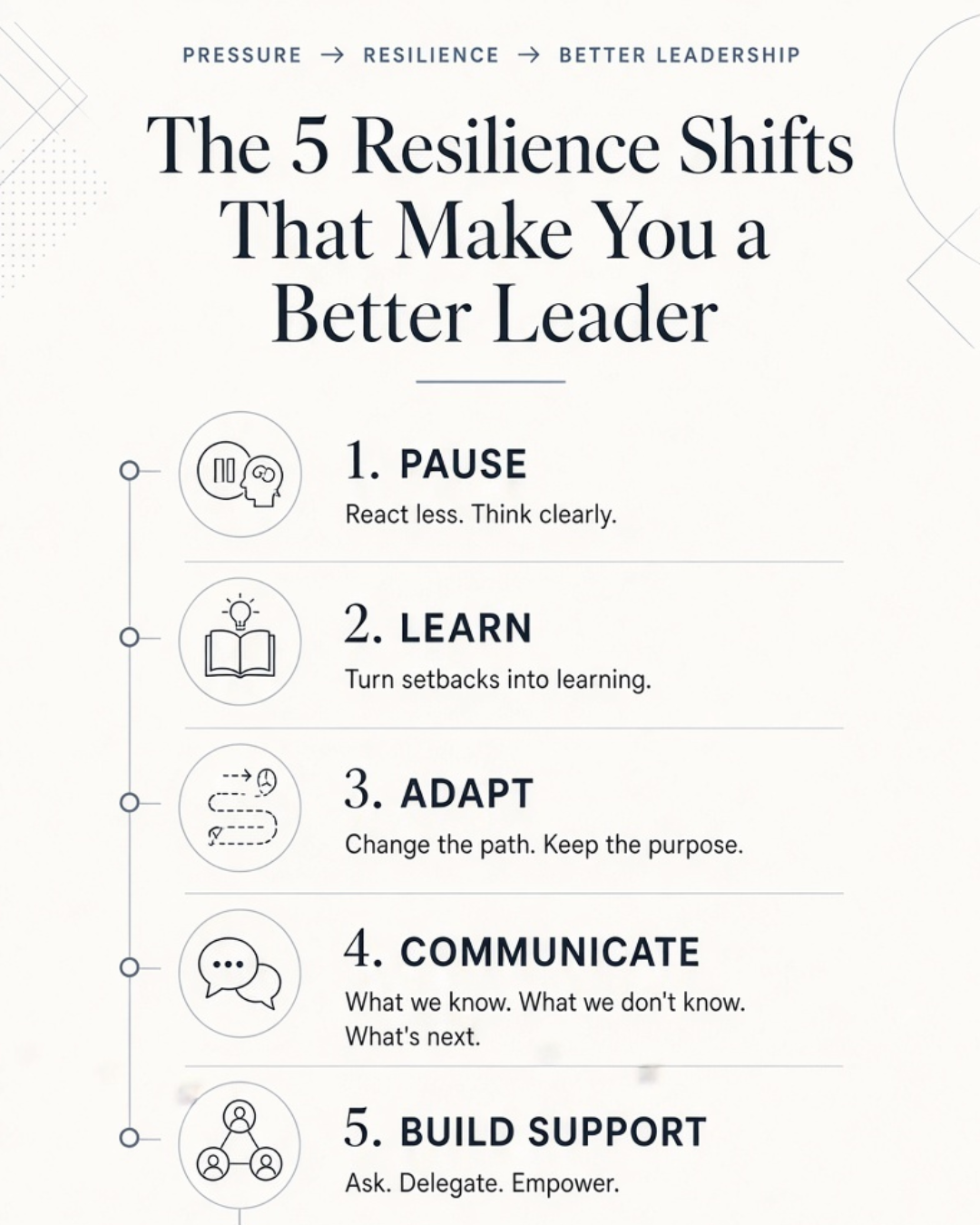
1. You Pause Before You React
Pressure triggers fast responses. In my experience working with leadership teams, the damage from an impulsive reaction under stress can linger for months, sometimes far longer than the original problem.
A resilient leader builds a deliberate pause between what happens and how they respond.
When you feel the pressure spike, try this:
Name your emotional response internally before saying anything.
Ask: What does this situation actually require from me right now?
Respond from that place, not from the emotion.
That pause changes the entire dynamic. Teams calibrate their own stress levels by watching their leader. When you pause, you model that it's safe to think before reacting.
2. You Turn Setbacks Into Learning
After a project misses, a hire doesn't work out, or a strategy falls flat, the instinct is to defend the decision, retreat, or spiral.
Resilient leaders do something different. They separate what happened from who they are.
The shift is simple to describe but harder to practice:
Reactive: "We failed. I should have known better."
Resilient: "Something about this approach didn't work. What was it?"
The questions I come back to with leaders after a setback:
What actually happened, not what I assumed?
Where did the reasoning break down?
What would I do differently now?
What does my team need to hear about what we learned?
Leaders who debrief honestly, with themselves and with their teams, create organizations that learn faster and recover stronger.
3. You Adapt When the Plan Stops Working
One of the most common leadership traps I see is what I call plan attachment: continuing to drive toward the original strategy long after circumstances have made it unworkable.
Resilient leaders aren't attached to the plan. They're attached to the purpose and flexible about the path.
When things shift, the best question I've found is:
"What can we actually influence right now, and what's the most important thing to accomplish in the next 30 days?"
That question alone resets a team. Instead of spinning on a six-month problem no one can fully solve today, you suddenly have focus and forward motion.
Practical moves when you need to adapt:
Shorten the planning horizon: 30-day priorities over six-month roadmaps
Communicate why you're adjusting, not just what is changing
Make the next decision with the information you have, don't wait for certainty that may not come
4. You Stay Honest When You Don't Have All the Answers
This is the most underestimated resilience skill I work on with executives.
There's enormous pressure on leaders to project certainty. I understand it: uncertainty makes teams anxious, and leaders feel responsible for that. But projecting false confidence almost always backfires. When employees sense that leadership is overpromising or withholding, they don't feel reassured. The rumor mill fills the gaps. Trust erodes quietly.
The more resilient approach sounds like this:
"Here's what we know. Here's what we don't know yet. Here's what we're doing next, and here's when we'll update you."
That four-part framework, know/don't know/doing/when, is something I come back to repeatedly with leadership teams during change and disruption. It isn't weakness. It's one of the most effective tools for holding organizational trust together under pressure.
According to CDC/NIOSH research on workplace stress, transparent communication from managers and supervisors is one of the most effective strategies for reducing organizational anxiety and maintaining team performance during high-stress periods.
If your communication strategies as a leader aren't built for uncertainty, they won't hold when uncertainty arrives.
5. You Build Support Instead of Carrying Everything Alone
Here's something that comes up repeatedly in leadership work: the leaders struggling most with resilience aren't necessarily the ones facing the hardest problems. They're often the ones trying to solve every problem themselves.
A leader who carries every decision becomes a bottleneck. A leader who builds support around themselves creates more capacity and models the kind of trust and interdependence that makes a whole team more resilient.
Resilient leaders know when to:
Ask a peer to challenge their thinking before they commit
Delegate real decision-making authority, not just tasks
Let the team surface and solve problems
Acknowledge when they need a different perspective
This is something I work through directly with leadership teams through advisory and consulting: how to distribute problem-solving without losing strategic coherence.
How to Practice Resilience as a Leader
Resilience isn't built in a seminar. It's built through real situations, reflected on deliberately.
Before a difficult situation, ask:
What's actually within my control?
What am I assuming that I haven't verified?
What does my team need from me right now?
During it, practice:
Pause before reacting
Separate facts from your interpretation
Focus on the next decision, not the entire problem
Say what you know and what you don't
After it, reflect:
How did I respond? How did my team respond to that?
What worked? What would I change?
What does my team still need from me?
Every difficult leadership moment is an opportunity to get better at the next one. The leaders I've seen build the most resilience aren't the ones who avoid hard situations. They're the ones who debrief them.
This is the foundation of what I build with leaders through leadership workshops and training: structured reflection around actual leadership situations.
Signs You're Becoming More Resilient as a Leader
These aren't dramatic transformations. They're quieter and more meaningful.
You respond instead of react when something goes wrong
You recover faster without carrying setbacks forward
You adapt direction without losing your purpose
You make decisions without waiting for certainty
You have difficult conversations earlier rather than postponing them
You communicate uncertainty more comfortably and honestly
You ask for a different perspective when you need one
You help your team stay focused when circumstances shift
The goal isn't to become someone unaffected by pressure. It's to become someone who can move through it without letting it derail your leadership or your team.
What Resilient Leadership Is Not
There's a lot of advice that conflates resilience with things it isn't. Let me be clear.
Resilient leadership does not mean:
Projecting positivity when things are genuinely hard
Hiding stress or uncertainty from your team
Working through exhaustion as proof of commitment
Pretending setbacks don't affect you
Taking every problem on yourself
What it does mean: a better leader isn't one who is unaffected by pressure. It's one who can acknowledge pressure and still respond thoughtfully.
Becoming a Better Leader Starts With How You Respond
The five behaviors: pause, learn, adapt, communicate, build support. They aren't separate tactics. They're interconnected. Practiced consistently, they change the kind of leader you become.
None of this requires you to be naturally calm or inherently optimistic. It requires something more honest: a willingness to keep getting better at the moments that are hardest.
In my work with leaders, the moments that challenge us most are almost always the ones that reveal where our leadership has the most room to grow.
Work With Tulios Consulting
Leadership challenges don't come with simple solutions. If your team is under pressure, your communication isn't landing, or you're navigating a period of uncertainty, you don't have to figure it out alone.
I work closely with executives and leadership teams to build the clarity, communication, and organizational alignment that makes resilience sustainable: not just in a crisis, but as a way of leading.
Frequently Asked Questions
How can leaders build resilience?
Through self-awareness, emotional regulation, honest reflection after setbacks, and building genuine support inside and outside their organizations. It's a practice built through experience, not a personality trait.
Why is resilience important for leaders?
Pressure, uncertainty, and setbacks aren't exceptions to leadership; they're part of the job. Resilience determines whether a leader stays effective and keeps the team functioning when those moments arrive.
How does resilience make a good leader?
It improves judgment under pressure, enables clearer communication during uncertainty, supports faster recovery from setbacks, and helps leaders hold team stability when circumstances are shifting.
What are 5 signs of poor resilience in a leader?
Impulsive reactions under pressure, difficulty adapting when plans change, taking setbacks personally, avoiding difficult conversations, and refusing support or outside perspective.
How to become a more resilient leader?
Pause before reacting, learn from setbacks rather than personalizing them, adapt when circumstances shift, communicate honestly during uncertainty, and build support instead of carrying everything alone.