
Executive Coaching vs. Leadership Training: What’s the Difference?
Key Takeaways
- Executive coaching is one-on-one, confidential, and built around a specific leader's behavioral challenges and growth.
- Leadership training is group-based, curriculum-driven, and designed to build shared skills and frameworks across teams.
- The right choice is not about which approach is better. It is about which one matches the problem your organization is actually facing.
- A knowledge gap calls for training. A behavior gap calls for coaching. An organizational gap may require both.
- When used together strategically, coaching and training reinforce each other and produce stronger, more lasting leadership outcomes.
Here is something I see inside organizations more often than it should happen: a senior leader is struggling. Their team is disengaged. They keep avoiding difficult conversations. A high-stakes transition is not going the way anyone hoped. So, the organization responds by signing them up for a leadership training program.
Six months later, nothing has changed.
Not because the training was bad. Because training was not the right tool for that problem.
I work with executives and leadership teams on some of the most complex organizational challenges they face. One of the most consistent patterns I see is this: organizations choose a leadership development program before they understand what kind of problem they are actually dealing with. The result is real investment, limited return, and leaders who feel more frustrated than supported.
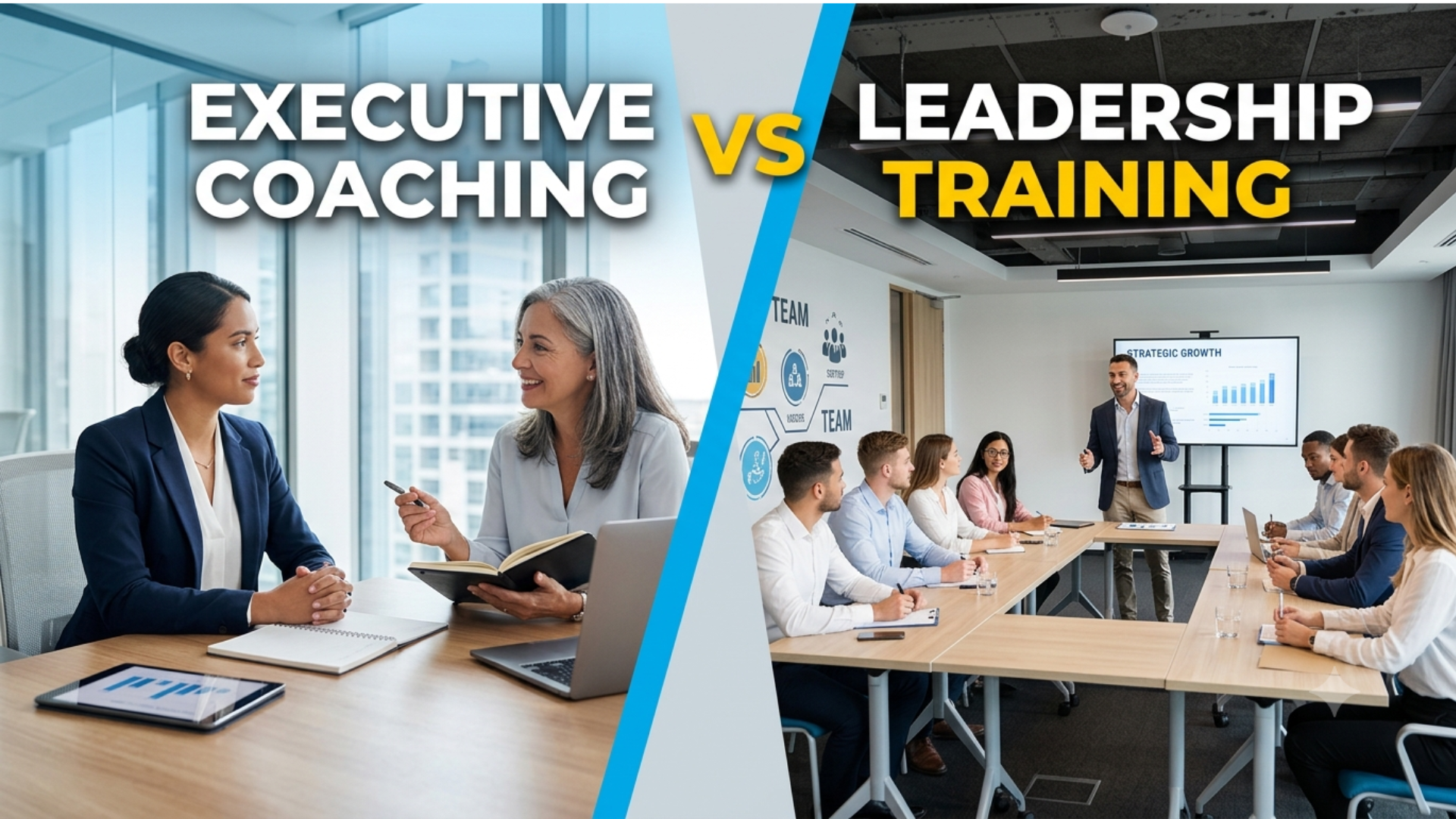
Executive coaching and leadership training are both powerful. But they solve different problems. Training teaches leaders what to do. Coaching helps leaders understand why they keep doing something else and then actually change it.
By the end of this article, you will know exactly how to tell these two approaches apart, which one fits your situation, and how to make a smarter decision before committing to either.
What Is the Difference Between Executive Coaching and Leadership Training?
Let me start with the structural differences, because they matter before anything else.
| Feature | Executive Coaching | Leadership Training |
|---|---|---|
| Format | One-on-one | Group-based |
| Focus | Individual challenges and behaviors | Shared skills and knowledge |
| Approach | Personalized and flexible | Structured and curriculum-based |
| Primary Goal | Behavioral and mindset development | Skill and knowledge development |
| Typical Audience | C-suite executives, senior leaders | Managers, emerging leaders, teams |
| Duration | Long-term (months to years) | Short-term (days to weeks) |
| Learning Style | Reflection, feedback, and application | Instruction, practice, shared learning |
That table shows you the mechanics. But the more important distinction runs deeper than format.
Executive coaching addresses who a leader is: how they think, behave, and show up under pressure.
Leadership training addresses what a leader knows: the skills, tools, and frameworks they need to perform effectively.
Both matter. They are just not the same thing, and they are not interchangeable.
How Does Executive Coaching Work?
Executive coaching is built around one leader and one set of real challenges. There is no fixed curriculum. No predetermined agenda. Each engagement is shaped entirely by what that executive is actually navigating, which is precisely what makes it effective for senior leaders dealing with complex situations.
The coaching relationship creates a confidential space where a leader can examine their own patterns honestly. That kind of self-examination is rare inside organizations, where most conversations carry professional risk. Coaching removes that risk and replaces it with the structured reflection that produces real behavioral change over time.
In practice, executive coaching typically focuses on:
Self-awareness and blind spots: Identifying the behaviors or patterns a leader may not see in themselves, even when others clearly do
Executive presence: How a leader communicates, holds a room, and is perceived by their team and peers
Decision-making under complexity: How leaders process ambiguity, manage uncertainty, and commit with confidence
Difficult conversations: Developing the capacity to address conflict, tension, or underperformance directly and constructively
Emotional intelligence: Understanding how emotional dynamics shape leadership relationships and team performance
Communication in high-stakes moments: What a leader says and how they say it when the pressure is highest
What separates coaching from training is not just the format. It is the depth of engagement. A skilled coach does not give a leader the answer. They create the conditions for a leader to develop a more effective response to their own situation, grounded in their own context, team, and leadership style.
Tip for senior leaders: If you have already completed training programs and the same challenge keeps showing up, that is a strong signal you are dealing with a behavior gap, not a knowledge gap. Coaching is almost certainly the more appropriate intervention.
How Does Leadership Training Work?
Leadership training is designed to scale, where coaching goes deep on one person, training goes broad across many, and that is exactly the point.
A well-designed leadership training program gives a group of leaders the same foundational knowledge, the same frameworks, and a shared leadership vocabulary. That consistency is often underestimated inside organizations. But when multiple managers are expected to lead the same way, communicate the same expectations, and hold the same standards, a shared foundation is not optional. It is essential.
Leadership training commonly covers:
Communication and feedback: How to give clear, constructive, and timely feedback that people can actually act on
Delegation and accountability: Assigning work effectively, following through, and building ownership at every level
Conflict management: Addressing team friction early, before it becomes a culture problem
Leadership fundamentals: The core competencies every manager needs before they can lead effectively
Team leadership: Building cohesion, trust, and sustained high performance across a team
According to the U.S. Office of Personnel Management, coaching is most effective when embedded within broader leadership development programs, not deployed as a standalone fix. That principle applies just as strongly in the private sector. Training and coaching work better together than either does alone.
Tip for HR and L&D leaders: Leadership training does not change who someone is. It gives them the tools to lead more effectively, and that is a strong, legitimate place to start. The mistake is expecting training to do the work that coaching is designed to do.
Coaching or Training? Start With the Problem, Not the Program
This is the step most organizations skip entirely, and it is the most important one.
Before you ask, "Which program should we choose?" ask a more useful question: "What kind of leadership gap are we actually dealing with?"
In my work with leadership teams, I have found that almost every leadership development challenge falls into one of three categories:
1. A Knowledge Gap
The leader, or a group of leaders, does not yet have the skill, framework, or information they need. They need to learn something they do not currently know. What it sounds like: "I have never managed a team this size before." What fits: Leadership training.
2. A Behavior Gap
The leader knows what they should do. They may have even completed training on it. But something keeps getting in the way of applying it consistently. What it sounds like: "I know I need to have that conversation. I just keep putting it off." What fits: Executive coaching.
3. An Organizational Gap
The problem is not one person's knowledge or behavior. It is the system those leaders are operating inside: misaligned expectations, inconsistent communication, conflicting priorities, or a culture that works against the leadership behaviors the organization says it values. What it sounds like: "We keep having the same conversations and nothing ever changes." What fits: A combination of coaching, training, and strategic advisory work.
That third category is the one most articles on this topic ignore entirely. And it is where organizations lose the most time and investment, because no amount of individual training or coaching will fix a systemic problem.
Executive Coaching Is the Better Fit When...
A senior leader is stepping into a more complex or high-stakes role
The challenge involves executive presence, interpersonal dynamics, or communication patterns
A leader's recurring behavior is creating friction, and they are already aware of it
The situation requires confidential, individualized support
The problem is nuanced, relational, or context-specific in a way a workshop cannot address
A leader already understands what they should do but struggles to apply it consistently
Leadership Training Is the Better Fit When...
Multiple leaders need to develop the same skill or competency at the same time
Newly promoted managers need a foundational leadership framework to work from
The organization needs a shared leadership language across departments or levels
The goal is scaling leadership capacity across a team, cohort, or organization
Specific, teachable skills like delegation, feedback, or conflict management need to be built
Can Executive Coaching and Leadership Training Work Together?
Yes. And in many organizations, the strongest leadership development strategy uses both deliberately.
Here is a sequenced approach I find works well in practice:
Step 1: Train the group
Give the broader leadership cohort a shared framework and a common skill set. This establishes the foundation.
Step 2: Observe the application
Notice which leaders are struggling to apply the learning in practice and identify what is getting in the way.
Step 3: Bring in coaching
Give those individuals the individualized support they need to bridge the gap between knowing and doing.
In this sequence, training and coaching do different jobs at different levels. Training builds the foundation. Coaching personalizes the application to each leader's real context.
For example,
An organization might provide communication training to the entire leadership team while simultaneously providing one or two executives with individualized coaching to address a specific communication pattern that is affecting their team's trust and performance.
These are not competing investments. Used together intentionally, they reinforce each other in a way that neither approach achieves alone.
Executive Coaching vs. Leadership Training: What to Consider
Use this table to make the call based on what your organization is actually facing.
| If the need is... | Consider... |
|---|---|
| Individual behavioral change | Executive coaching |
| Confidential support for a senior leader | Executive coaching |
| A complex or high-stakes leadership challenge | Executive coaching |
| Shared leadership skills across a team | Leadership training |
| New manager development | Leadership training |
| Building a consistent leadership framework | Leadership training |
| Individual and shared development needs | Both |
| Organizational alignment or culture challenges | Advisory consulting and both |
Find the Right Leadership Development Approach for Your Organization
The difference between executive coaching and leadership training is not about which approach is more valuable. It is about which one fits the problem your organization is actually facing right now.
In my experience working with senior leaders and executive teams, the most common and costly mistake is not choosing the wrong program. It is choosing a program before diagnosing the problem. Training gets assigned when coaching is what is needed. Coaching gets engaged when the challenge is actually organizational and systemic.
At Tulios, I work with organizations and senior leaders to understand what kind of challenge they are facing and to determine whether the answer is individualized development, structured training, strategic consulting, or a deliberate combination of all three.
Explore Leadership Workshops and Training, Emerging Leadership Coaching, and Communication Strategies for Leaders to see how Tulios supports leaders at every level. Or reach out directly to talk through what your organization needs.
Frequently Asked Questions
What is the difference between executive coaching and leadership training?
Executive coaching is a one-on-one, personalized process focused on a specific leader's behavioral development, mindset, and complex challenges. Leadership training is a structured, group-based program that builds shared skills and frameworks across multiple leaders at once. Training addresses what leaders know. Coaching addresses how they actually lead.
How does leadership training differ from coaching?
Leadership training delivers a predefined curriculum to a group, building consistent skills and a shared leadership language across many people at once. Coaching is flexible, individualized, and shaped entirely around one leader's real situation, with no fixed agenda and no group component.
Can executive coaching improve leadership skills?
Yes, though the mechanism is different from training. Coaching does not teach skills from a curriculum. It helps leaders identify the specific behaviors, patterns, or blind spots limiting their effectiveness and develop more intentional responses grounded in their own leadership context.
When should you choose coaching over training?
Coaching is the better fit when a leader already knows what they should do but struggles to apply it consistently, or when the challenge is behavioral, interpersonal, or too contextual for a structured program to address. If the problem is specific to one person and requires confidential support, coaching is almost certainly the right path.
What are the outcomes of executive coaching and leadership training?
Leadership training produces shared competencies, consistent frameworks, and scalable skill development across a group. Executive coaching produces deeper behavioral change, stronger self-awareness, and improved leadership effectiveness in complex, high-stakes situations. Both produce meaningful outcomes when matched to the right problem.
How does executive coaching enhance leadership effectiveness?
Coaching helps leaders see their own blind spots, develop stronger emotional intelligence, and make more intentional decisions under pressure. Over time, this produces more effective communication, stronger teams, and better organizational results.